Boötes Constellation: Brightest Star, Shape, and Star Charts
Discover the Boötes constellation: its brightest star Arcturus, how to find its kite shape, and its place in star charts. A factual guide for skywatchers.

What Is the Boötes Constellation?
Boötes is a large constellation in the northern celestial hemisphere, easily recognized by its distinctive kite or ice-cream-cone shape. Its name comes from the Greek word for "herdsman," and it is often depicted as a bear driver chasing the Great Bear (Ursa Major) around the pole. Boötes is home to several interesting stars and deep-sky objects, making it a favorite among amateur astronomers.
The Brightest Star: Arcturus
Arcturus (Alpha Boötis) is the brightest star in Boötes and the fourth-brightest star in the entire night sky. It has an apparent magnitude of -0.05, making it easily visible to the naked eye even from light-polluted areas. Arcturus is an orange giant star, cooler than the Sun but much larger and more luminous. Its distinct orange hue is a helpful marker for identifying the constellation.
How to Find Boötes in the Night Sky
Locating Boötes is straightforward if you know a few key landmarks. The constellation is best seen in the evening sky during spring and early summer in the Northern Hemisphere.
Using the Big Dipper’s Handle
One of the most reliable methods is to follow the arc of the Big Dipper’s handle. Imagine a curved line extending from the handle’s end, and you will "arc to Arcturus"—a well-known mnemonic. Once you spot the bright orange star, you have found the base of the kite shape.
Using the Spring Triangle
Boötes also forms part of the Spring Triangle, a large asterism that includes Arcturus, Spica (in Virgo), and Regulus (in Leo). By identifying these three bright stars, you can quickly locate Boötes and its neighboring constellations.
Boötes in Star Charts and Astronomy
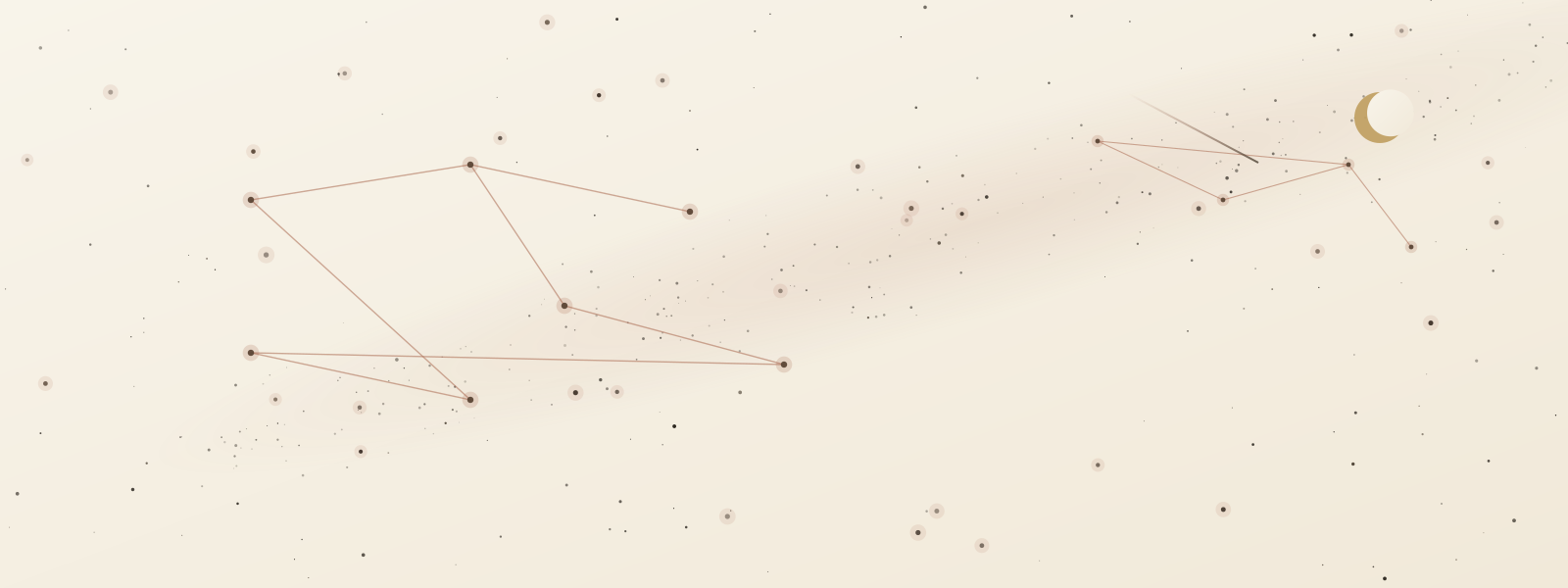
On a star chart, Boötes is typically drawn with its brightest stars connected to form a kite or a pentagon with a elongated tail. The constellation covers a large area of 907 square degrees, ranking 13th among the 88 recognized constellations. It contains several notable deep-sky objects, such as the Boötes Void (a vast, nearly empty region of space) and the quasar 3C 273, but these require telescopes to observe.
Historical and Cultural Notes
Boötes has been recognized since ancient times. In Greek mythology, it is often associated with Arcas, the son of Zeus and Callisto, who was placed in the sky as a bear driver. The constellation also appears in the works of Homer and Aratus. In Chinese astronomy, the stars of Boötes were part of the Black Tortoise of the North and the Azure Dragon of the East, showing how different cultures mapped the same stars.