Canis Major: Brightest Star, Shape, and Star Charts
Discover Canis Major, the Great Dog constellation, home to Sirius, the brightest star. Learn how to find its shape, its role in star charts, and how a Vivfora star map can capture the sky above your special moment.

The Brightest Star: Sirius and Its Magnitude
Canis Major, the Great Dog, is dominated by Sirius, the brightest star in the night sky. Sirius has an apparent magnitude of −1.46, making it nearly twice as bright as the next brightest star, Canopus. This brilliance is due to both its intrinsic luminosity—about 25 times that of the Sun—and its proximity, at just 8.6 light-years away. Sirius is a binary system, with a faint white dwarf companion, Sirius B, often called "the Pup." The star's name comes from the Greek word for "scorching," a nod to its association with the summer heat.
Finding the Shape of Canis Major in the Night Sky
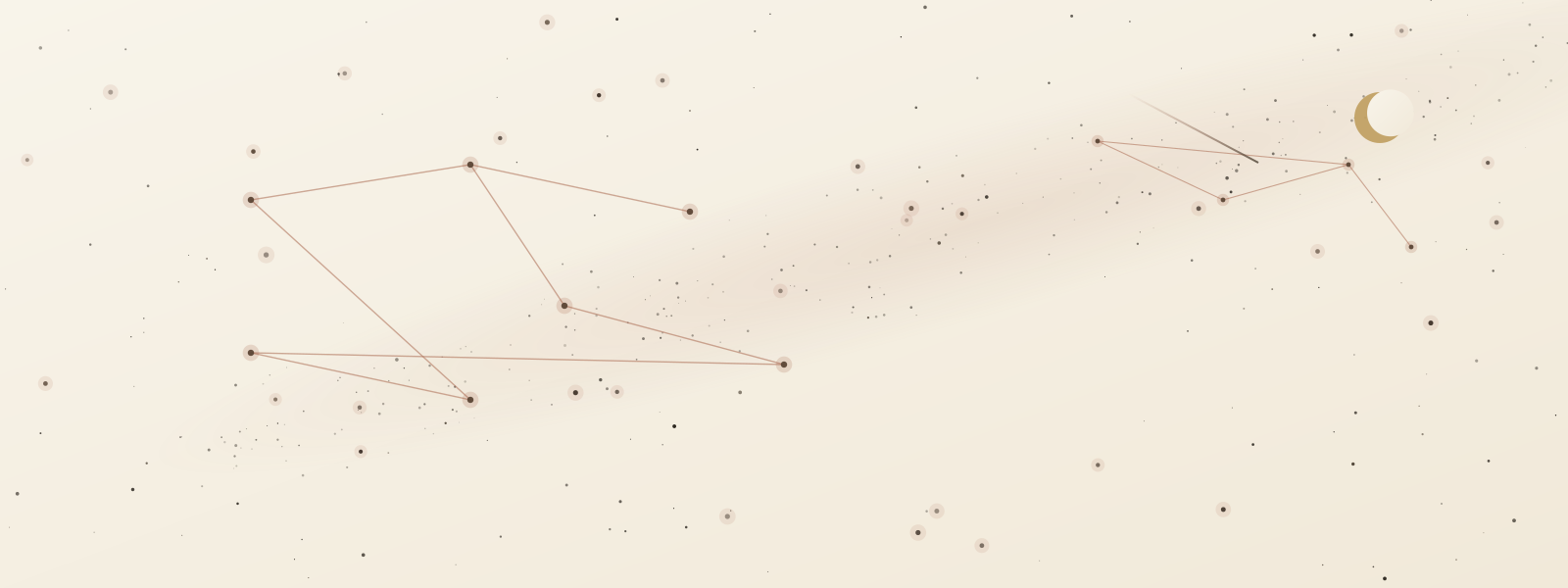
Locating Canis Major is straightforward once you identify Orion. Follow the line of Orion's Belt downward and to the left (in the Northern Hemisphere) to reach Sirius. The constellation's main stars form a distinctive shape: a large dog with Sirius at the neck or chest, a head to the south, and a body extending eastward. Key stars include Mirzam (β Canis Majoris), Wezen (δ), and Adhara (ε). Adhara is particularly notable as one of the brightest ultraviolet sources in the sky. The dog's hind legs are marked by Aludra (η) and Furud (ζ). Under dark skies, the Milky Way runs through the constellation, adding a rich background of clusters and nebulae.
Step-by-Step Star Hopping
- Start at Orion's Belt (three stars in a row).
- Draw a line through the belt from left to right (eastward) and extend it about 10 degrees to find Sirius.
- From Sirius, look south for the head (marked by Muliphein, γ) and east for the body and legs.
- Use a star chart or app to confirm the fainter stars.
Canis Major in Star Charts and Celestial Cartography
Canis Major is one of the 48 constellations listed by Ptolemy and remains one of the 88 modern constellations. It appears on star charts as a large, sprawling figure south of the celestial equator, bordered by Monoceros, Lepus, Columba, and Puppis. Its position along the Milky Way makes it a favorite for deep-sky observers. Star charts typically show Sirius as the alpha star, with the constellation's outline tracing the dog's form. In planispheres and digital charts, Canis Major is prominent during Northern Hemisphere winter evenings and Southern Hemisphere summer nights.
The Mythological and Cultural Context of Canis Major
In Greek mythology, Canis Major represents the dog of Orion, or sometimes Laelaps, the hound that never failed to catch its prey. The constellation is also linked to the "dog days" of summer, when Sirius rose with the Sun and was thought to bring heat and drought. In other cultures, the stars of Canis Major were part of different asterisms—for example, in Chinese astronomy, Sirius was known as Tianlang, the Heavenly Wolf.