Carina Constellation: Brightest Star, How to Find It, and Its Place in Star Charts
Explore the Carina constellation: its brightest star Canopus, tips to find its shape, and its role in star charts. Plus, discover Vivfora's custom star maps.

What Is the Carina Constellation?
Carina is a constellation in the southern celestial hemisphere, representing the keel of a ship in ancient Greek mythology. It was once part of the larger constellation Argo Navis, which was divided into three parts—Carina (the keel), Puppis (the stern), and Vela (the sails)—by the French astronomer Nicolas-Louis de Lacaille in the 18th century. Today, Carina is one of the 88 officially recognized constellations and is best known for hosting Canopus, the second-brightest star in the night sky.
Carina covers an area of 494 square degrees, making it the 34th largest constellation. It is bordered by several other constellations, including Vela, Puppis, Pictor, Volans, Chamaeleon, Musca, Centaurus, and Hydra. The constellation is rich in deep-sky objects, such as the Carina Nebula (NGC 3372), a vast star-forming region that contains the hypergiant star Eta Carinae.
The Brightest Star: Canopus
Canopus (Alpha Carinae) is the brightest star in Carina and the second-brightest star in the entire night sky after Sirius. It has an apparent visual magnitude of −0.74, making it an exceptionally brilliant point of light. Canopus is a white supergiant star located about 310 light-years from Earth. Its luminosity is roughly 10,700 times that of the Sun, and it is one of the most intrinsically luminous stars visible to the naked eye.
Because of its brightness, Canopus has been used as a navigational reference for centuries. In modern times, it serves as a guide star for spacecraft and is often used to orient star trackers. For stargazers, Canopus is an excellent starting point for exploring the southern sky.
How to Find Carina in the Night Sky
Carina is best visible from southern latitudes during the months of January through May. Observers in the southern hemisphere can see it high in the sky, while those in the northern hemisphere may catch a glimpse near the horizon if they are south of about 20°N latitude.
Using Nearby Constellations as Guides
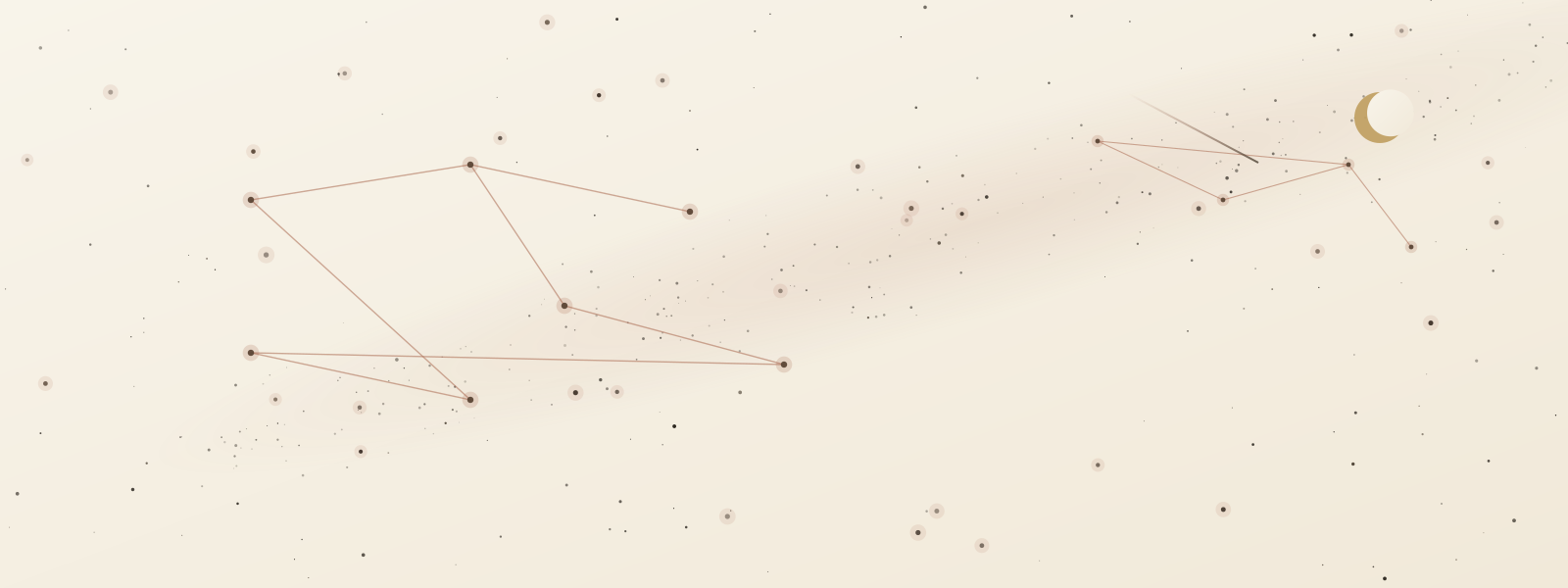
To locate Carina, first find Canopus, which is easy to spot because of its brightness. Canopus is located roughly 36 degrees south of Sirius, the brightest star in the sky. Once you have found Canopus, look for the fainter stars that form the keel shape of Carina. The constellation extends from Canopus toward the southeast, passing through stars such as Miaplacidus (Beta Carinae) and Avior (Epsilon Carinae).
Another useful guide is the Southern Cross (Crux), which points toward Carina. Draw a line from the long axis of the Cross and extend it about 4.5 times its length to the east, and you will arrive near the bright star Miaplacidus.