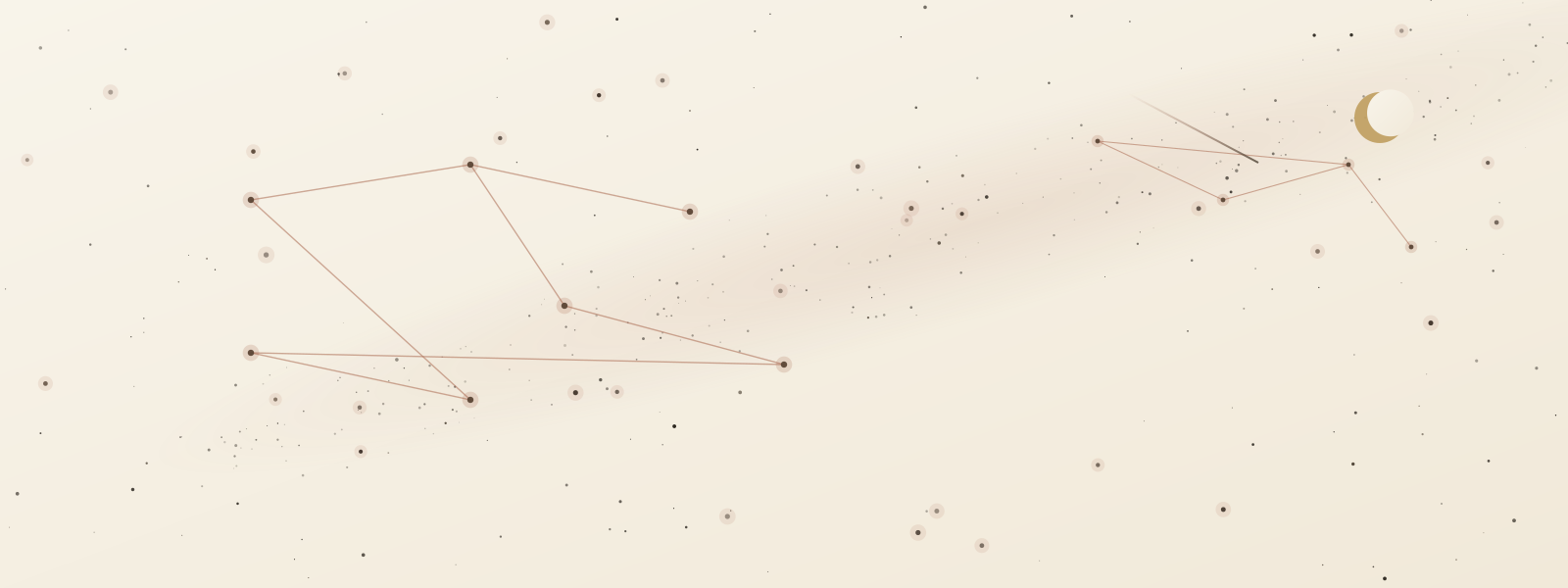
Centaurus Constellation: Brightest Star, Shape, and Star Charts
Explore the Centaurus constellation: its brightest star Alpha Centauri, how to find its shape, and its place in star charts. Includes a real-sky star map link.

What Is the Centaurus Constellation?
Centaurus is one of the 88 modern constellations and among the largest in the sky. It represents a centaur—a creature from Greek mythology—and is best known for hosting Alpha Centauri, the closest star system to our Sun. Located in the southern celestial hemisphere, Centaurus is visible from many parts of the world, though its full glory is reserved for southern latitudes.
The Brightest Star: Alpha Centauri
Alpha Centauri is the brightest star in Centaurus and the third brightest in the night sky, with an apparent magnitude of -0.27. It is actually a triple star system: Alpha Centauri A and B form a binary pair, while Proxima Centauri (Alpha Centauri C) is a faint red dwarf and the closest known star to Earth at about 4.24 light-years away. The system lies in the constellation's southern portion and is a favorite target for stargazers.
How to Find Centaurus in the Night Sky
Centaurus is a sprawling constellation that can be challenging to trace. Its brightest stars form a distinctive pattern that resembles a centaur holding a spear or a beast. Here’s how to locate it:
Step-by-Step Guide
- Use the Southern Cross (Crux) as a pointer: The long axis of Crux points toward Alpha Centauri. Draw an imaginary line from Gamma Crucis through Acrux and extend it about 4.5 times; you'll arrive near Alpha Centauri.
- Look for the two brightest stars: Alpha Centauri and Beta Centauri (Hadar) are known as the "Southern Pointers" because they point to the Southern Cross.
- Trace the centaur's body: From Alpha Centauri, move northeast to find Beta Centauri, then continue to the fainter stars that outline the centaur's body and legs.
- Best viewing times: In the southern hemisphere, Centaurus is prominent during autumn and winter evenings (March–September). From northern latitudes, only the southern part of the constellation rises above the horizon.
Centaurus in Star Charts and Astronomy
Centaurus appears on star charts as a large constellation bordered by Hydra, Antlia, Vela, and other southern constellations. It contains several notable deep-sky objects, including Omega Centauri (the largest globular cluster in the Milky Way) and Centaurus A (a prominent radio galaxy). Star charts often highlight these features, making Centaurus a rewarding area for telescopic exploration.