
Lyra Constellation: Brightest Star, Night Sky Guide, and Star Charts
Discover the Lyra constellation: its brightest star Vega, tips to find its shape, and its role in star charts. Learn how a custom star map captures the sky above any moment.
What Is the Lyra Constellation?
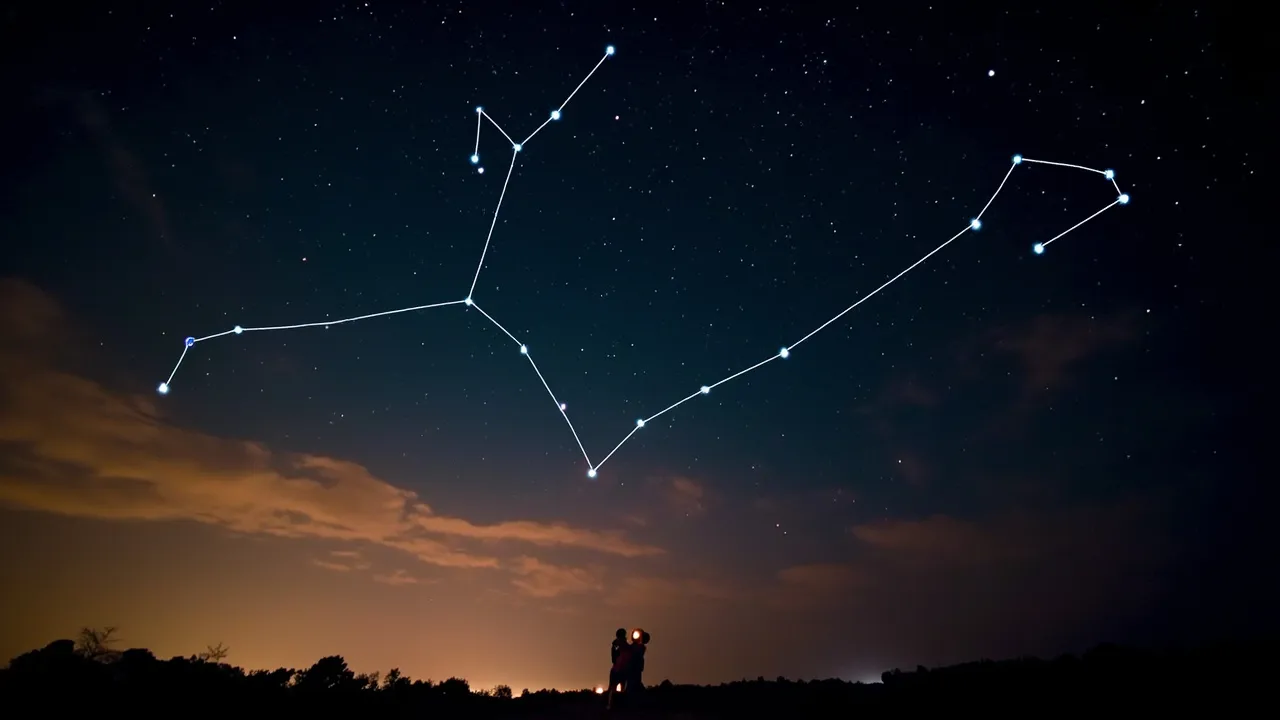
Lyra is a small but prominent constellation in the northern sky, representing the harp of Orpheus in Greek mythology. It is one of the 48 constellations listed by the 2nd-century astronomer Ptolemy and remains one of the 88 modern constellations recognized by the International Astronomical Union. Lyra is best known for containing Vega, the fifth-brightest star in the night sky and the brightest star in the constellation.
Vega: The Brightest Star of Lyra
Vega (Alpha Lyrae) is a brilliant white main-sequence star located about 25 light-years from Earth. With an apparent magnitude of +0.03, it is the fifth-brightest star overall and the second-brightest in the northern celestial hemisphere after Arcturus. Vega has played a significant role in astronomy: it was the first star ever photographed (in 1850) and was long used as a standard for calibrating photometric systems. Together with Deneb and Altair, Vega forms the Summer Triangle, a large asterism visible in the northern summer sky.
How to Find Lyra in the Night Sky
Locating Lyra is straightforward once you identify Vega. Here are steps to find the constellation:
- Start with the Summer Triangle: During summer evenings in the Northern Hemisphere, look for three bright stars forming a large triangle. Vega is the brightest of the three.
- Look for the parallelogram: Lyra's main shape is a small parallelogram of stars attached to Vega. This pattern is often described as a harp or a lyre.
- Use nearby constellations: Lyra is bordered by Draco to the north, Hercules to the west, and Cygnus to the east. Finding these can help confirm your location.
- Best viewing times: Lyra is highest in the sky during summer months in the Northern Hemisphere, but it is visible for much of the year from mid-northern latitudes.
For observers in the Southern Hemisphere, Lyra appears low on the northern horizon during winter months.
Lyra in Star Charts and Astronomy
Lyra is included in all major star charts and planispheres. Its position near the zenith during summer makes it a favorite target for amateur astronomers. The constellation contains several interesting deep-sky objects, including the Ring Nebula (M57), a planetary nebula, and the globular cluster M56. Star charts typically show Lyra's boundaries and its principal stars, with Vega often labeled prominently. In celestial cartography, Lyra is used as a reference point for locating other objects, and its stars are part of the basis for the equatorial coordinate system.