
Vela Constellation: Brightest Star, Shape, and Star Charts
A factual reference to the Vela constellation: its brightest star Gamma Velorum at about magnitude 1.8, how to trace its loose sail-like shape, and how it appears on star charts.
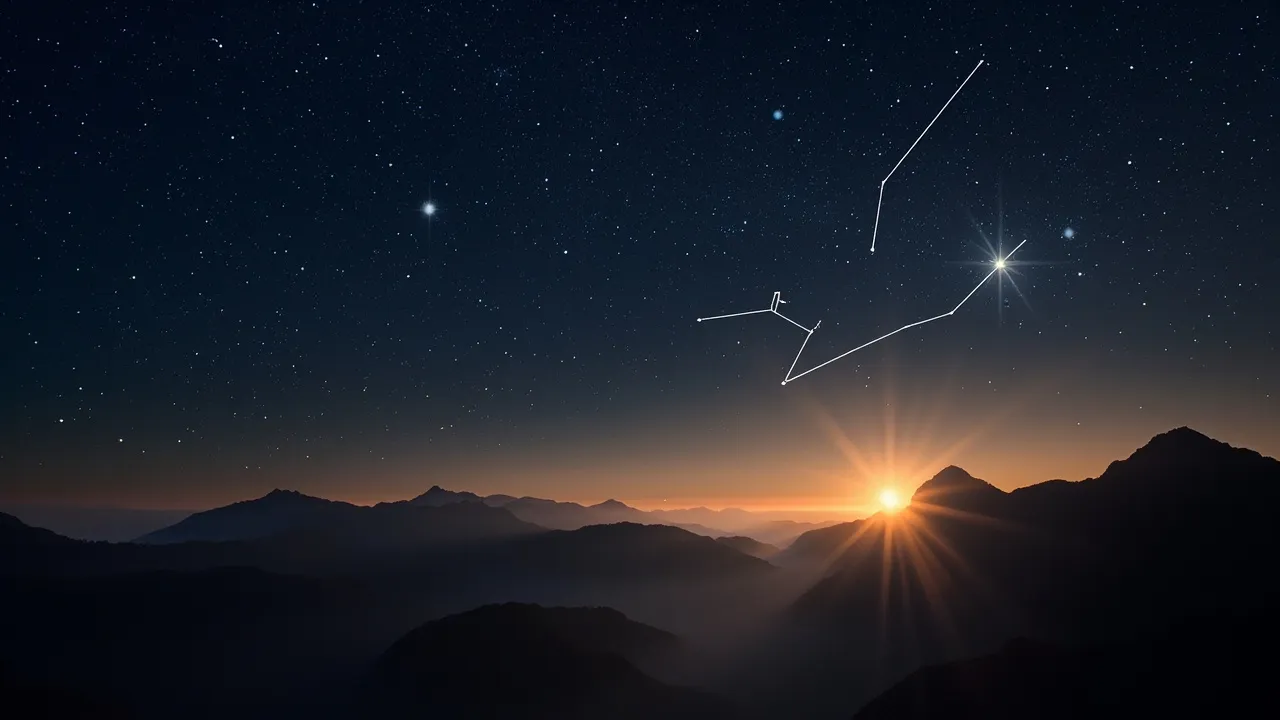
Where Vela Sits in the Southern Sky
Vela is one of the three constellations that once formed the ancient Greek figure Argo Navis, the ship of the Argonauts. When astronomers in the 18th century reorganized that oversized figure, it was split into Carina (the keel), Puppis (the stern), and Vela (the sails). Vela keeps the middle section of the old ship, and its abbreviated form is Vel.
It lies in the southern celestial hemisphere, bordered by Antlia, Pyxis, Puppis, Carina, Centaurus, and Phoenix. For observers in the northern hemisphere, Vela is either invisible or only partly above the horizon; from mid-northern latitudes the constellation's northern edges may skim the southern horizon on spring evenings. From the southern hemisphere it is a familiar sight, crossing the sky between roughly January and April.
The Brightest Star: Gamma Velorum
The brightest star in Vela is Gamma Velorum, also known by the traditional name Regor. Its apparent magnitude is about 1.8, which places it among the brighter stars visible to the unaided eye. Gamma Velorum is not a single star but a multiple system; its dominant component is a hot, luminous star, and the system is famous among astronomers for the strong emission lines in its spectrum.
A useful comparison: at magnitude 1.8, Gamma Velorum is noticeably fainter than Sirius (about -1.4) but brighter than most stars in the surrounding sky. Under a dark sky it is easy to spot; from a light-polluted city it may still be visible when it is well placed. The second-brightest star in the constellation is Delta Velorum, around magnitude 1.9, followed by Lambda Velorum (about 2.2) and Kappa Velorum (about 2.5).
How to Trace the Shape of Vela
Vela is not a compact, obvious figure. Its stars form a loose, sprawling pattern that many observers describe as a rough sail or a bent quadrilateral. The practical approach is to anchor yourself on the brightest stars and work outward.
- Start with Gamma Velorum, the brightest point in the constellation.
- Move toward Delta Velorum and Lambda Velorum to sketch the main body of the figure.
- Use Kappa Velorum and the fainter stars around it to complete the sail-like outline.
- Look for the neighboring pair of bright stars in Centaurus as a reference point; Vela sits to their east.
The constellation also contains the Vela pulsar, a well-studied neutron star, and the Gum Nebula, a large emission nebula. These are not visible to the unaided eye, but they are part of why Vela appears frequently in astronomy references.
Vela on Star Charts and in the Historical Record
On a printed or digital star chart, Vela is drawn with its boundaries and its principal stars, and its position is given in right ascension and declination. Charts usually mark Gamma Velorum with its magnitude and label the constellation with the abbreviation Vel. Because the old ship Argo Navis was divided, some historical charts still show the sails as part of a single large figure, which can confuse readers comparing older atlases with modern ones.
The constellation's name comes from the Latin for sails, and its stars were catalogued long before the modern boundaries were fixed. That history is why Vela is often described as a remnant of a larger constellation rather than a figure with its own classical mythology.
Reading Vela at a Chosen Moment
A star chart is most useful when it reflects the sky you actually see. A Vivfora star map charts the real sky above any chosen moment, so the position of Vela and its neighbors matches the date, time, and place you select. If you want to see how the constellation sits above a particular city on a particular evening, you can explore the custom star map for your chosen moment and compare it with what you observe.
For readers who enjoy pairing sky-watching with quiet rituals, the same principle of careful observation applies to scent: an Eastern Aromatherapy Pouch placed nearby can support relaxation during an evening of stargazing, and the wider collection of Chinese heritage crafts offers other objects made with similar attention to detail. Keep any aromatic pouch away from children and pets, and check the ingredient list if you have known sensitivities.