
Sandalwood Bracelet for Men: A Buyer's Guide to Materials & Wear
A practical buyer's guide to sandalwood bracelets for men: species and scent, grain and finish, sizing by bead diameter, daily care, and what to confirm before ordering.
What a Sandalwood Bracelet Actually Is
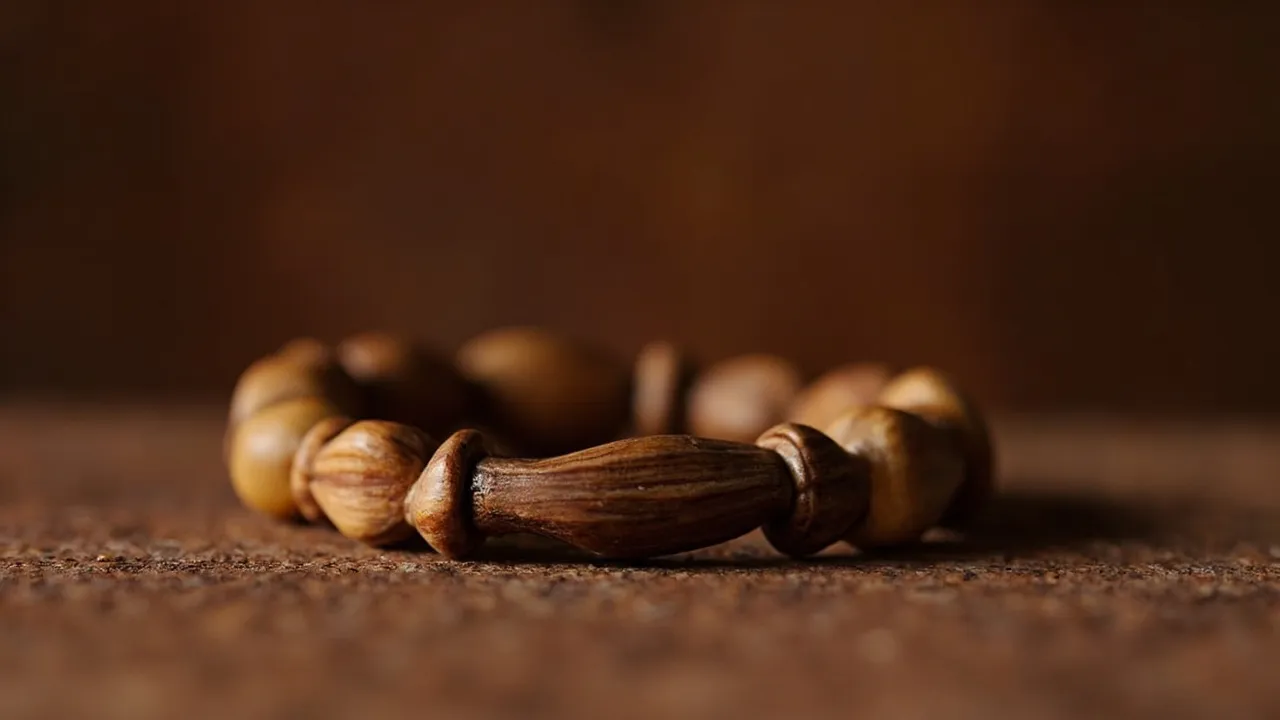
A sandalwood bracelet is a strand of rounded wooden beads, usually threaded on an elastic cord and worn on the wrist. The wood comes from trees in the Santalum genus, and the part that matters is the heartwood — the dense inner wood that holds the aromatic oils. In Chinese craft contexts the material is known as tanxiang, and it has a long history in carving, incense and small personal objects.
Three things define a sandalwood bracelet worth owning:
- Species and origin. Indian sandalwood (Santalum album) is the benchmark for density and scent. Australian sandalwood (Santalum spicatum) is a different species with a lighter, drier profile. Both are legitimate; they are not the same product.
- Age of the wood. Older heartwood carries more oil. Newly cut wood smells sharp and fades faster.
- Bead work. Look at whether beads are uniform in diameter, whether holes are centred, and whether the surface is smoothly finished rather than lacquered.
Scent is the giveaway. Genuine sandalwood smells warm, creamy and slightly woody — never like perfume or soap. If a bracelet hits you with a strong synthetic fragrance the moment you open the box, you are probably smelling an oil applied to a cheaper wood.
Why Sandalwood Suits Men's Everyday Wear
Most men's jewellery advice pushes toward metal: steel, titanium, silver. Wood offers something different. It is light, it does not go cold against the skin, and it sits quietly next to a watch without competing with it.
A sandalwood bracelet also ages. Beads darken slightly with handling, the surface takes on a soft sheen from skin contact, and the scent settles into something subtler. That patina is the point — it is a piece that looks better in year two than in week one.
In practice, this makes it a good fit for:
- Office days where a metal cuff feels like too much.
- Weekend and travel wear, since wood is light and does not scratch laptop surfaces.
- Layered looks with a leather strap watch or a plain band.
One honest caveat: wood and water are not friends. A sandalwood bracelet is not a swimming or shower bracelet, and it will not survive a hot tub.
Reading the Wood: Grain, Colour and Scent
Colour across genuine sandalwood ranges from pale honey to deep reddish brown. Variation between beads is normal and is one of the ways to tell real wood from a uniform synthetic. What you want is consistency of quality, not identical colour.
Grain should be visible on close inspection — fine lines running across the bead surface. Heavy lacquer hides grain, and it also seals in the wood so the scent cannot develop.
On scent, be realistic. A new bracelet may smell strong for the first few weeks and then calm down considerably. That is expected. Light sanding with fine abrasive paper can refresh the surface, but do it sparingly; each pass removes a little wood.
How to Choose the Right Size and Fit
Bracelet sizing is where most online orders go wrong. Measure your wrist with a soft tape just below the wrist bone, then add roughly 1.5–2 cm for a comfortable fit, or 2.5 cm if you prefer a looser drape.
Bead diameter changes the look more than the length does:
- 6–7 mm reads delicate and stacks well.
- 8 mm is the most common men's size and the safest default.
- 10 mm and above is a statement piece and needs a wider wrist to sit well.
Elastic cord is the standard closure. Check that the knot is recessed into a bead rather than sitting exposed, and ask whether the cord is doubled. A single-strand elastic will fail eventually; doubled cord lasts considerably longer.
What to Check Before You Order
Before checkout, confirm these points in the listing or by asking the seller directly:
- Species name, not just "sandalwood."
- Bead diameter and wrist length, stated in numbers.
- Cord type and whether it is replaceable.
- Finish — natural polish versus lacquer or wax.
- Return policy, especially for scent-based dissatisfaction.
If a listing claims the scent will last for years, consider that as marketing rather than fact. Aromatic woods fade; that is the nature of the material.
More Sandalwood Bracelet For Men: a factual buyer's guide for jew to Explore
Readers who enjoyed this guide usually continue with Sandalwood Bracelet For Men: a factual buyer's guide for jew products and related heritage pieces:
- Sandalwood Bracelet for Men: A Buyer's Guide to Materials & Wear — the exact product featured in this article
- Herbal sachet collection — hand-tied aromatic pouches, ready to ship
- All Chinese heritage crafts and wellness goods — browse the full catalogue
Featured pieces in this story
Silver care, sizing and styling guides — plus first look at new pieces. Unsubscribe in one click.